
Ancient Yoga, India's Sacred Mission, and the Global Movement That PM Modi Built
Yoga is not merely an exercise — it is a civilisational gift from ancient India to the entire world. From the banks of the Indus Valley to the beaches of Visakhapatnam, from the verses of Patanjali to the halls of the United Nations, the story of yoga is the story of India's spiritual generosity. And at the heart of yoga's modern global journey stands one defining act of leadership: Prime Minister Narendra Modi's proposal to the United Nations that gave the world International Yoga Day.
The Ancient Roots of Yoga — Where It All Began
More than 5,000 years ago, in the great civilisation of the Indus Valley, humanity's most profound wellness science was born. Seals excavated at Mohenjo-Daro and Harappa depict figures seated in meditative postures — evidence that yoga is not a modern invention, but an ancient inheritance. The very word 'Yoga' comes from the Sanskrit root 'Yuj', meaning to unite, to yoke, to join — the union of individual consciousness with universal consciousness.
The Rigveda, among the oldest of human texts, first speaks of yoga as a disciplined approach to life. Over millennia, this practice evolved through the Upanishads, the Bhagavad Gita, and reached its most systematised form in the Yoga Sutras of the sage Patanjali — a masterwork composed around 400 CE that distilled the entire science of yoga into 196 concise aphorisms. Patanjali's Ashtanga (Eight-Limbed) Yoga — encompassing ethical disciplines, postures, breath control, sense withdrawal, concentration, meditation, and ultimate absorption — remains the philosophical backbone of all yoga practice today.
India's Sacred Mission — Sharing Yoga With the World
India has never hoarded its wisdom. From the moment Swami Vivekananda electrified the Parliament of World's Religions in Chicago in 1893 — introducing the West to the profound depth of Hindu philosophy and yoga — India embarked on a sacred mission: to share its ancient knowledge with all humanity, irrespective of religion, nationality, or background.
Legends followed. Paramahansa Yogananda brought Kriya Yoga to America in the 1920s through his immortal 'Autobiography of a Yogi'. Swami Sivananda spread yogic teachings across continents through his Divine Life Society. B.K.S. Iyengar introduced the precision of Hatha Yoga to Europe and America, even teaching the violin maestro Yehudi Menuhin. Pattabhi Jois made Ashtanga Vinyasa a global phenomenon. T. Krishnamacharya, the father of modern yoga, trained generations of masters whose influence spans the entire world.
Each of these luminaries carried forward what India has always known: that yoga is a technology for human transformation — and it belongs to all.
Yoga is not a religion. It is a science — science of well-being, science of youthfulness, science of integrating body, mind and soul.
The Birth of International Yoga Day — A Historic UN Resolution
On September 27, 2014, Prime Minister Narendra Modi addressed the United Nations General Assembly for the first time as India's Prime Minister. In that landmark speech, he made a proposal that would change the world's relationship with yoga forever: the declaration of an International Day of Yoga on June 21 — the summer solstice, the longest day of the year in the Northern Hemisphere, and a date of deep significance in many spiritual traditions.
The response was extraordinary. A record 177 co-sponsoring nations supported the resolution — the highest number of co-sponsors for any UN General Assembly resolution of its kind. On December 11, 2014, the United Nations officially proclaimed June 21 as the International Day of Yoga. On June 21, 2015, the very first International Yoga Day was celebrated, with PM Modi himself leading a mass yoga demonstration of over 35,000 participants on Rajpath in New Delhi — a world record that entered the Guinness Book.
This was not merely a diplomatic achievement. It was a civilisational moment — the world formally acknowledging India's greatest gift to humanity.
Yoga is an invaluable gift of India's ancient tradition. It embodies unity of mind and body, thought and action, restraint and fulfilment, harmony between man and nature.
PM Modi's Transformative Role — From Vision to Global Movement
What makes PM Modi's contribution exceptional is not just the UN proposal — it is his sustained, personal commitment to making yoga a living reality for billions of people. Every year since 2015, PM Modi has personally led the national celebration of International Yoga Day, choosing iconic locations across India — Rajpath in Delhi, Chandigarh, Dehradun, Lucknow, Mysuru Palace, Jammu, and in 2025, the magnificent RK Beach in Visakhapatnam.
Under his government, India created the Ministry of AYUSH — dedicated to the promotion of Ayurveda, Yoga, Unani, Siddha, and Homeopathy — which has institutionalised yoga in national health policy, school curricula, hospitals, defence forces, and diplomatic missions worldwide. The M-Yoga App, launched in partnership with WHO, made yoga content available to millions globally in multiple languages. India's yoga teachers and institutions now operate in over 190 countries.
PM Modi has consistently articulated yoga as more than exercise — as a path to peace in a fractured world. 'At a time when the whole world is going through some kind of tensions,' he said at Visakhapatnam in 2025, 'yoga gives a direction of peace and brings oneness.' This is the vision that has elevated International Yoga Day from a fitness event to a global movement of unity.
International Yoga Day 2025 — 'Yoga for One Earth, One Health'
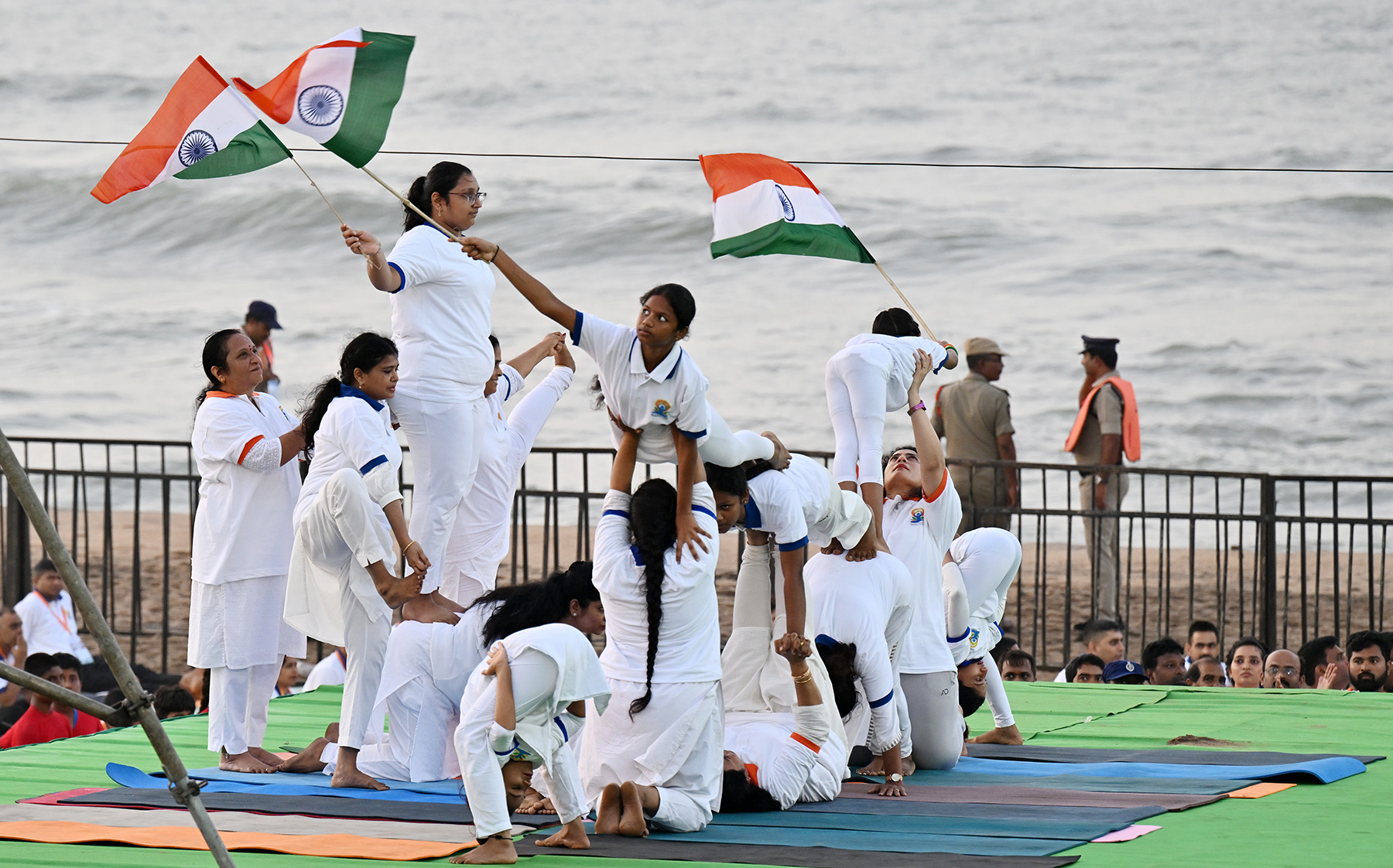
June 21, 2025 marked the 11th International Yoga Day, celebrated under the powerful theme 'Yoga for One Earth, One Health' — a call to recognise that the health of the individual, the community, and the planet are inseparable. Dressed in his signature white, PM Modi led a mass yoga session at Visakhapatnam's iconic RK Beach, Andhra Pradesh, with over three lakh participants gathered at the beach front alone — synchronised with more than ten lakh locations across India under the 'Yoga Sangam' initiative.
The scale of participation was staggering. In Andhra Pradesh alone, 2.45 crore people registered to participate in the day's celebrations — a number that speaks to the extraordinary grassroots penetration yoga has achieved under India's leadership. New world records were set. Union Ministers, Chief Ministers, defence personnel, students, senior citizens, and differently-abled individuals all participated in events across the country. In Hyderabad, over 3,000 differently-abled individuals performed yoga — a beautiful symbol of yoga's inclusive spirit.
Globally, the day reverberated from New York to Nepal, from Bangladesh to South Africa. The Embassy of India in Nepal organised a yoga demonstration at Pokhara Rangshaala Stadium with over 7,000 enthusiasts. In South Africa, events were held at UNESCO World Heritage sites including the Cradle of Humankind. The United Nations hosted its own Yoga Day event at headquarters in New York. Finance Minister Nirmala Sitharaman, who attended celebrations in Faridabad, noted that yoga has evolved into a powerful global health movement since the first International Yoga Day in 2015.
Why Yoga Belongs to the World — and Why India Leads
Yoga has no passport. It does not ask your religion, your language, or your nationality. A grandmother in Mumbai and a corporate professional in Berlin can both find in yoga the same quietude, the same strength, the same clarity. This is precisely what makes yoga unique among India's contributions to world civilisation — it is immediately, personally transformative for anyone who practises it.
India's role is not that of a proprietor — it is that of a generous teacher. The knowledge was always meant to be shared. What India asks in return is only acknowledgement of its source, respect for its depth, and sincerity in its practice. PM Modi's initiative at the United Nations was, in its essence, a continuation of this ancient tradition of sharing — bringing India's 5,000-year-old wisdom into the institutions of the 21st century.
- Over 300 million people worldwide now practise yoga regularly
- UNESCO has inscribed India's Yoga onto its Intangible Cultural Heritage list
- 177 nations co-sponsored the UN resolution for International Yoga Day in 2014
- India's Ministry of AYUSH promotes yoga in over 190 countries
- The M-Yoga App offers WHO-endorsed yoga content in multiple languages globally
- June 21 — International Yoga Day — is now one of the most observed UN days worldwide
From the Vedas to Visakhapatnam — The Unbroken Thread
There is a beautiful unbroken thread that runs from the Rigveda to RK Beach, from Patanjali's quiet ashram to the United Nations podium, from Swami Vivekananda's Chicago address to PM Modi's vision of 'One Earth, One Health'. This thread is yoga — and it is India's most enduring gift to the world.
As we celebrate International Yoga Day each June 21, we do not merely stretch our bodies or calm our minds. We participate in something ancient, something vast — a living tradition that has outlasted empires and thrived across centuries precisely because it speaks to what is most fundamental in every human being: the desire to be well, to be at peace, and to be connected.
India has carried this flame for five millennia. Under the visionary leadership of PM Narendra Modi, it has ensured that this flame now lights up every corner of the world. International Yoga Day is not a celebration of one nation's culture — it is a celebration of humanity's deepest wisdom, shared freely with love.
Conclusion
From the ancient seers who first codified the science of yoga to the Prime Minister who brought it to the United Nations — from the sages of the Upanishads to the millions who unrolled their mats on Visakhapatnam's golden beach — yoga's journey is India's greatest story. Roll out your mat. Breathe. The ancient wisdom is alive, and it belongs to you.
Yoga is not India's past. It is humanity's future — and India, as always, is lighting the way.
Tags